
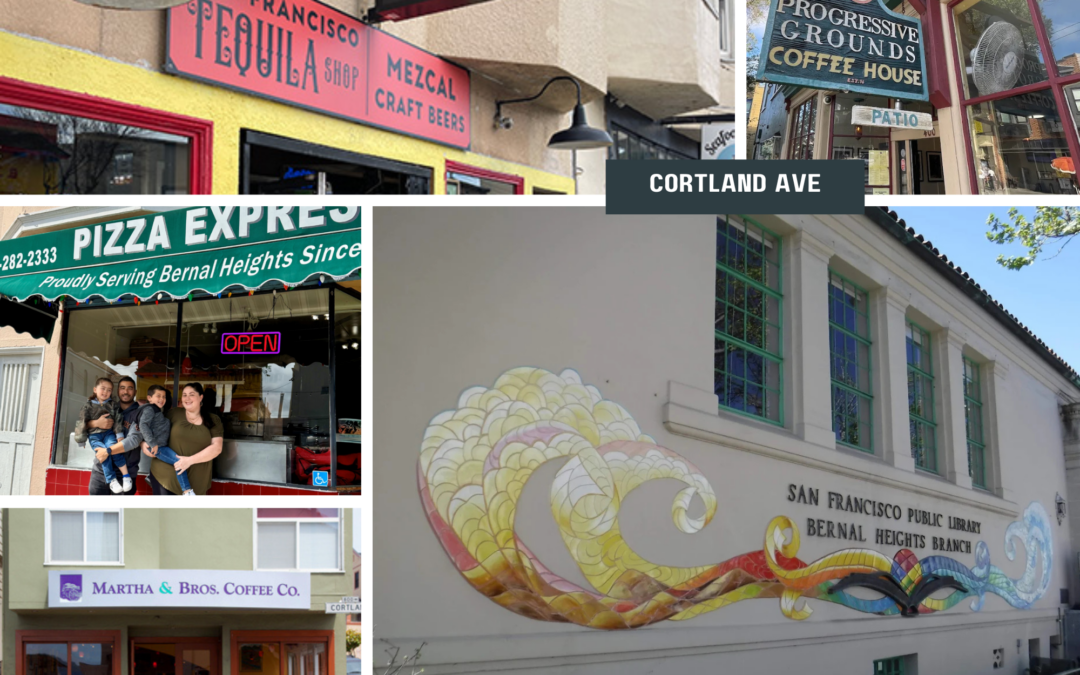
CORTLAND AVENUE: THE MAIN STREET THAT TIME COULDN’T TAME
A Portrait of Bernal Heights, San Francisco
There are streets in San Francisco that shimmer with the city’s ambition, Market, Valencia, Hayes, where the newest is always the point. And then there is Cortland Avenue, which hums with something older and more enduring: the quiet authority of a place that knows exactly what it is. Running through the heart of Bernal Heights along the city’s southern ridge, Cortland is the kind of main street that movies are made of, and that most cities have long since paved over.
It is, at once, a farmer’s errand, a Sunday morning ritual, a political forum, and a dining destination. To walk its dozen or so commercial blocks, roughly from Mission Street to the foot of the hill’s eastern slope, is to walk through a living argument that San Francisco’s soul is not yet lost.
Bernal Heights itself sits on a bedrock of radiolarian chert, ancient, compressed, earthquake-resistant, and that geological stubbornness seems to have seeped into the character of the neighborhood it supports. While surrounding districts have cycled through tech booms, gold rushes, and waves of displacement, Bernal and its main artery have remained, if not unchanged, at least recognizably themselves.
ORIGINS & HISTORY: BUILT ON BEDROCK, SHAPED BY IMMIGRANTS
The land that Cortland Avenue now traverses was once part of Rancho Rincon de las Salinas y Potrero Viejo, a 4,446-acre Mexican land grant awarded to José Cornelio Bernal in 1839. By the 1860s, a French financier named François Louis Alfred Pioche had acquired the land and begun subdividing it, and Army engineers from the Presidio laid out Bernal’s streets, which is why so many of its streets bear the names of military men.
The neighborhood’s first wave of settlers were Irish immigrants who farmed the land and ran dairy ranches across the grassy hilltop. The 1906 earthquake proved pivotal: built atop seismic-dampening chert, Bernal’s structures survived the tremor in far better shape than the rest of the city. As San Francisco rebuilt itself, Cortland’s commercial corridor grew organically, a collection of shops and services for the workers and families who streamed into newly built homes on the hill’s slopes.
A BRIEF HISTORY IN DATES
1839 — Mexican Land Grant
José Cornelio Bernal receives the 4,446-acre rancho. The land is farmed by Irish immigrants who establish dairy operations on the grassy hilltop.
1906 — The Earthquake & Aftermath
Bernal’s bedrock saves its buildings. As the city rebuilds, Cortland fills with shops serving workers in new homes. Tiny earthquake cottages, some of which still stand, shelter refugees.
1920 — A Library Deposit Station Opens
A library deposit station opens at 303 Cortland, anchoring the avenue’s civic life. It moved to 324 Cortland in 1936 as the neighborhood grew.
1940 — Bernal Heights Library Dedicated
Designed by prolific architect Frederick H. Meyer and funded by the Works Progress Administration, the library at 500 Cortland opens at a cost of $94,600, the 21st branch in the San Francisco system.
1970s — “Red Hill” & The Wild Side West
Anti-war activists earned the neighborhood the nickname “Red Hill.” Around 1977, Wild Side West, a queer and lesbian bar with a legendary back garden, opens on Cortland, becoming a community institution. When they moved, they brought the physical back bar and mirrors from the North Beach location.
1979 — The Neighborhood Center was founded
A strong tradition of community activism led to the establishment of the Bernal Heights Neighborhood Center, which promotes organizing, affordable housing, and youth services.
1991–Today — Good Life Grocery & Modern Anchors
Good Life Grocery, a beloved natural foods store, opened on Cortland in 1991. New restaurants, bakeries, and specialty shops continue to root themselves here, drawn by the avenue’s unshakeable community identity.
CIVIC LIFE: THE LIBRARY, THE BAR, AND THE BLOCK PARTY
Few streets can claim a civic institution as beloved as the Bernal Heights Branch Library at 500 Cortland. Built on the site of the original Bernal School and dedicated on October 21, 1940, the WPA-funded building became a neighborhood anchor for generations. When it closed for renovations in 2008, the community fought passionately over the murals adorning its exterior, a dispute that speaks to how seriously Bernal takes its public spaces. After a $5.7 million renovation, the library reopened on January 30, 2010, just in time for its 70th anniversary.
Just down the block, Wild Side West has anchored Cortland’s queer identity since approximately 1977. With its rambling back garden and lived-in décor, it is one of the oldest lesbian bars in San Francisco, a place that outlasted the Castro’s party years and the tech boom’s dislocations alike. Its presence on Cortland is a reminder that the avenue’s diversity has always been structural, not decorative.
The Bernal Heights Neighborhood Center, established in 1979, hosts Fiesta on the Hill, one of the last summer street fairs of the season, featuring petting zoos, dancing, and live music. It is the sort of event that couldn’t be manufactured; it simply grew out of a place where people still know their neighbors’ names.
Halloween on Cortland: The Great Bernal Migration
Every October 31st, the street-level dynamic of the neighborhood undergoes a total shift. Vehicles are replaced by a literal river of costumed children, parents, and dogs, turning the avenue into a closed-off, car-free corridor that feels like a block party on a massive scale.
Why It’s More Than Just Candy
The logistics of the evening are a testament to community organization. Because Cortland Avenue serves as the neighborhood’s spine, closing it for several blocks creates a safe, contained environment that is increasingly rare in San Francisco.
- The Local Buy-In: The event is anchored by local businesses that treat the holiday as a core part of their annual calendar. Shop owners don’t just hand out candy; they transform their storefronts, creating a seamless, walkable experience from Mission Street to the library.
The “Greening” Connection: Through the coordination of local nonprofits like Greening Projects, the event emphasizes sustainability alongside the fun. It serves as a showcase for what happens when a community takes control of its public space, prioritizing human connection over traffic flow.
The Social Fabric: You will see the generational range of Bernal here. It is one of the few nights a year when you are guaranteed to cross paths with your neighbors from the East Slope, the North Slope, and the West Slope all in one place.
The Bernal Vibe
The costumes on Cortland usually lean toward the creative and the hyper-local. You’ll see plenty of standard superheroes, but expect a heavy dose of “Bernal-specific” ingenuity, hand-crafted costumes referencing local gardening projects, the hill’s famous wind, or nods to the neighborhood’s long history of activism.
Tips for the Night
If you are planning to head down to Cortland for the festivities:
- Go Early: The street is most vibrant between 4:00 PM and 7:00 PM, before the youngest trick-or-treaters start heading home.
- Respect the Boundaries: As the street is closed to vehicles, plan to walk or bike in. The parking situation on the surrounding hill is, as always, a challenge.
- Participate: The event is fueled by participants’ energy. Whether you are in costume or just there to soak up the atmosphere, you are part of the “Living Room” culture that defines Cortland.
FOOD & DRINK: A CULINARY CORRIDOR UNLIKE ANY OTHER
Cortland Avenue has always fed its neighborhood, but in recent years it has emerged as one of San Francisco’s most compelling dining destinations, a strip whose restaurants are chosen by discerning locals rather than driven by tourist itineraries or social media optimization.
The arrival of Go Duck Yourself at 439 Cortland crystallized what the street had become. Opened by brothers Eric and Simon Cheung, who grew up helping their family run Hing Lung, the beloved Chinatown roast house, the restaurant was named one of the ten best new Bay Area restaurants of 2024 by the San Francisco Chronicle. The Cheungs analyzed their delivery data and found that many of their Chinatown customers were already coming from Bernal Heights; Cortland offered an ideal location, rooted in community, easily accessible to the peninsula.
They join an eclectic constellation of established neighbors:
Avedano’s at 235 Cortland, one of the few whole-animal butchers left in San Francisco, run by Bernal resident Angela Wilson and offering sustainably raised guinea fowl, goose, and prime rib alongside monthly butchery classes.
The Bernal Bakery at 521 Cortland — born from a pandemic-era pop-up — produces laminated doughs fermented for 24 hours and cultishly popular apple cider donuts that, as one co-owner warns, “People revolt if we take them off the menu.”
Good Life Grocery, a natural foods institution since 1991, anchors everyday shopping.
Black Jet Baking at 833 Cortland satisfies the neighborhood’s sweet tooth.
United Dumplings at 525 Cortland draws noodle lovers across the city.
For a proper sit-down meal, 3rd Cousin offers contemporary New American cooking with a thoughtful wine list
Even the corner bodega, Andi’s Market at 1000 Cortland, confounds expectations, stocking kamut, Fly By Jing chili crisp, and obscure Iranian saffron-pistachio ice cream alongside the usual provisions.
Explore the full Bernal Heights Food & Dining Directory for more hidden gems on the hill.
CHARACTER & COMMUNITY: WHAT CORTLAND AVENUE REALLY IS
There is a nickname that has followed Bernal Heights through its various eras: Maternal Heights. It was coined to describe the neighborhood’s appeal to young families seeking an affordable first home, and it captures something true about Cortland Avenue as well. The street has a maternal quality: nourishing, opinionated, unimpressed by trends, deeply concerned with the well-being of whoever lives nearby.
Bernal’s political tradition runs deep. During the Vietnam War era, the neighborhood was known as “Red Hill” for the anti-war activists and collectives who moved in among working-class families. That spirit of activism eventually crystallized into the Bernal Heights Neighborhood Center in 1979, which to this day promotes community organizing, affordable housing, senior services, and youth programs. Cortland Avenue is, in a real sense, the physical expression of those values: locally owned, community-anchored, resistant to the homogenizing forces that have claimed so many of San Francisco’s other commercial corridors.
The Bernal Heights Outdoor Cinema screens free films by local filmmakers each fall. The San Francisco Illegal Soapbox Derby sends makeshift cars careening down Bernal Hill each year. The Alemany Farmers’ Market — one of the oldest in the country, operating every Saturday since August 4, 1947- anchors the neighborhood’s eastern edge. These are not manufactured amenities. They are the accretion of decades of people who decided that where they lived mattered, and acted accordingly.
Cortland Avenue is not without its tensions. Gentrification and rising property values have steadily displaced working-class homeowners and renters in favor of urban professionals. The beloved businesses that define the street are not immune to economic pressure. But the avenue’s track record, its capacity to absorb new arrivals and new establishments without losing its essential character, is a testament to the depth of the community that surrounds it.
San Francisco is a city that often seems to be in the process of forgetting what it was. Cortland Avenue is one of the places where memories are kept. Come for the roast duck, the apple cider donuts, or the bar with the garden. Stay because you recognize something you didn’t know you’d been missing.
“Cortland Avenue is a neighborhood that still feels like a village — where the people dining and shopping here are intentional about it, living alongside neighbors, regulars, and in-the-know San Franciscans.”
Do you have a favorite memory of Cortland Avenue or a hidden spot we missed? Submit your own local story or leave a comment below to help us keep this portrait growing.
Four Corners of the Hill

Author: Mike Doherty: Bernal Connect
Mike Doherty serves as Chief Experience Officer at Greening Projects, a nonprofit organization dedicated to transforming underutilized urban spaces into vibrant green areas that benefit communities and the environment.
