
Precita Park: The Quiet Heart of Bernal Heights
Precita Park has anchored its corner of San Francisco since 1894. More than just open grass and a children’s playground, it is the living room of a neighborhood that refuses to lose its soul.
On most mornings, before the fog has fully lifted from Bernal Hill, Precita Park already belongs to its people. Dog owners fan out across the lawn, coffee cups in hand. Parents push strollers along Precita Avenue. A retiree reads on the same bench he has occupied for years. The neighborhood’s 2.06 acres of open green, tucked between Folsom Street and Alabama Street, hums with an ordinary, irreplaceable life.
What makes Precita Park remarkable is not any single feature, but the density of community it has accumulated over 130 years. Established in 1894 as Bernal Park and renamed in 1973 to honor Precita Creek, the waterway that still flows in pipes beneath the streets, the park has outlasted eras of rapid change in San Francisco while remaining stubbornly, cheerfully local.
A Park Built for Gathering
Divided into two distinct zones, the park offers something for nearly everyone. The eastern end holds a colorful, fully gated playground, one of the most beloved in the San Francisco Recreation and Parks system, complete with a butterfly garden that draws families year-round. The western expanse opens into a broad grassy field, ideal for Frisbee, picnic blankets, and the kind of unhurried afternoon that feels increasingly rare in the city.
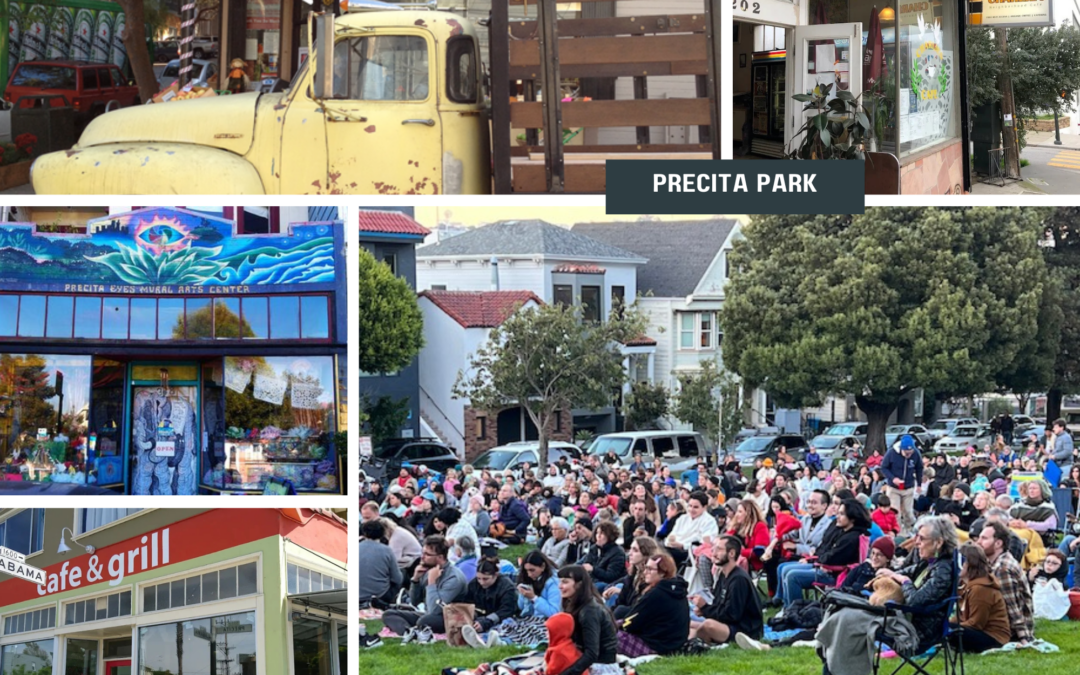
Every year, the park hosts Bernal’s Outdoor Cinema, drawing neighbors together under the open sky for an evening film. The Precita Valley Neighbors organization has long coordinated volunteer cleanups and community events, working to preserve both the physical park and the social fabric it supports.
Where Art Lives on the Walls
No account of Precita Park’s neighborhood is complete without Precita Eyes Muralists, the community-based nonprofit that has shaped the visual identity of this corner of San Francisco for nearly five decades. Founded in 1977 by Susan Cervantes and her husband, Luis, the organization grew from a single collaborative mural at the Bernal Heights Library into one of the most important mural arts institutions in the United States.
The name itself is rooted in place: most of the founding muralists lived in Precita Valley, taking their name from Precita Creek below. Their Studio sits directly across from the park at 348 Precita Avenue, a deliberate positioning that ties the organization’s identity to the neighborhood’s green heart. Weekend walking tours, led by working muralists, take visitors through Balmy Alley and along 24th Street, unpacking the cultural, political, and historical significance of works spanning the Chicano movement of the 1970s through contemporary commentaries on gentrification and community resilience. (OG Classic Mural Tour led by Patricia Rose)
The Businesses That Shape the Block
A park does not thrive in isolation. The businesses ringing Precita Park and the streets radiating from it form an ecosystem of daily life, places that serve not just transactions but community.
Precita Park Cafe sits at 500 Precita Ave, anchoring the park’s southeast corner. Woman- and LGBTQ-owned, it sources from local, family-run suppliers, cage-free eggs, organic produce, coffee from local roasters, and runs dinner service Tuesday through Sunday. A short walk away, Charlie’s Cafe has earned its place as a true neighborhood anchor: the kind of unpretentious, reliably good spot where regulars are greeted by name, and the coffee keeps coming. It fills a different niche than the Park Cafe: less a brunch destination, more a daily ritual.
For groceries and errands, Harvest Hills Market is the neighborhood’s dependable anchor, a focus on fresh produce and quality groceries that supports the kind of cooking and daily life that makes a neighborhood feel like a neighborhood. Precita Clean keeps things practical, a neighborhood laundromat that, like all good ones, doubles as an informal community hub where locals catch up while waiting for their cycles to finish.
Evenings draw people to Los Yaquis, a Bernal Heights institution beloved for its Sonoran-style Mexican food and loyal neighborhood clientele. Precita Social has become an essential companion to the park’s social life, a laid-back gathering place where the conversation runs long, and the atmosphere feels like an extension of the neighborhood itself. Think of it as the indoor version of what happens on the park benches on a warm Sunday afternoon. Hop Oast Pub & Brewery rounds out the options for those seeking craft beer and an easy post-park pint.
Not all of the park’s neighbors deal in food and drink. Architect Mason Kirby, at 306 Precita Avenue, is a full-service architectural and interiors practice that has called the park home since 2005. A member of the American Institute of Architects and the US Green Building Council, the firm brings a sustainability-minded approach to residential and commercial design, and has repaid the neighborhood’s hospitality by hosting the Edible Architecture Competition, an only-in-San-Francisco event where participants build structures out of food, with judging held in the park itself.
A Neighborhood That Holds Its Ground
San Francisco has changed enormously in the decades since Precita Park was renamed in 1973. Waves of newcomers, technology money, and the relentless pressure of housing costs have reshaped most of the city beyond recognition. Bernal Heights and the Precita Park area have not been immune – but they have, in notable ways, resisted erasure.
The key may lie in the park itself. Open green space of this quality, ringed by genuine neighborhood institutions rather than chains, creates the conditions for community to persist. When people have a reason to walk outside every day, to let the dog run, take the children to the playground, buy coffee from someone who knows their name, or show up on a Saturday morning to sweep the paths alongside neighbors, the neighborhood reproduces itself. Precita Clean, the Social Club, the mural tours, the market runs to Harvest Hills, the afternoon at Charlie’s: all of it circles back to the park as its center of gravity.
For residents, it can be easy to take for granted. For visitors, stepping into the park on a clear afternoon, sun slanting across the grass, the hill rising behind, children’s voices from the playground, the smell of coffee drifting from the cafe, it becomes immediately clear why people choose to build a life here, and why, once built, they work hard to keep it.
Four Corners of the Hill

Author: Mike Doherty: Bernal Connect
Mike Doherty serves as Chief Experience Officer at Greening Projects, a nonprofit organization dedicated to transforming underutilized urban spaces into vibrant green areas that benefit communities and the environment.
