
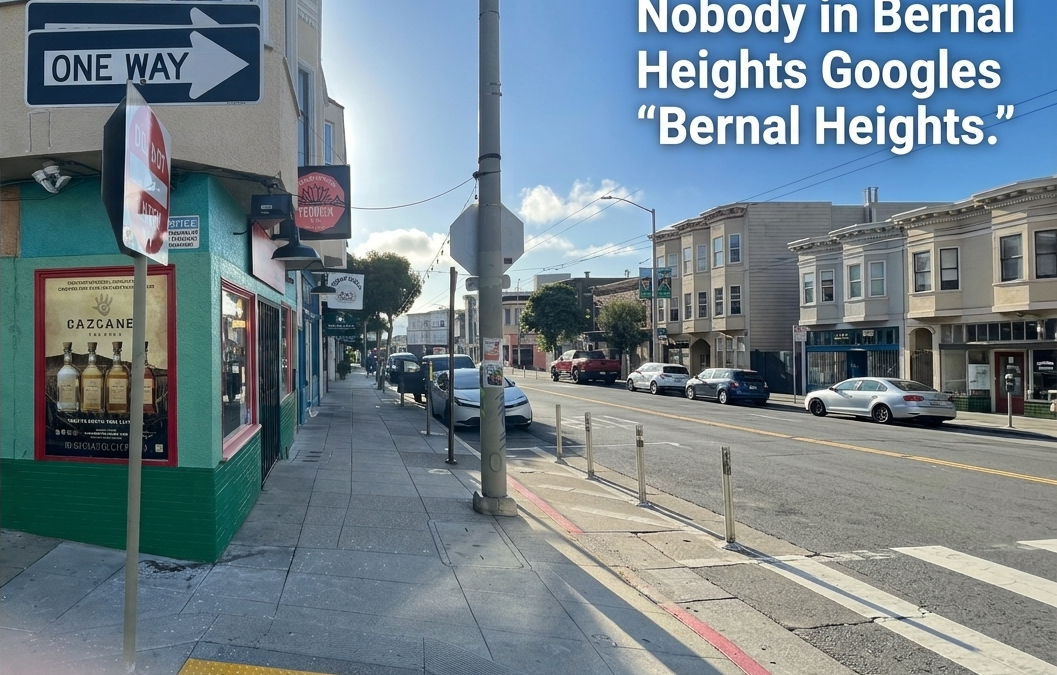
Nobody in Bernal Heights Googles “Bernal Heights.” They Google “Near Me.” Here’s How to Show Up When They Do.
A four-part framework for turning your storefront into the answer AI search engines give your neighbors
The claim: As search shifts from link lists to AI-generated answers, the businesses that win will be the ones that build content, data, and reputation around their specific block, not their neighborhood as a whole.
Why the Common Approach Fails
Most Bernal Heights business owners still optimize the way SEO worked a decade ago: pick a keyword like “Bernal Heights bakery” or “Bernal Heights plumber,” work it into the homepage a few times, and assume Google will notice.
That approach has a structural problem now. AI answer engines don’t rank a list of pages for someone to click through; they assemble one specific answer. Ask an assistant “where’s a good coffee shop near me,” and the model isn’t scanning for a keyword match; it’s pulling together your location data, your schema markup, the language in your reviews, and whatever third parties say about you, then stitching that into a single response. A page that only mentions “Bernal Heights” in the headline doesn’t give the model much to work with once the user is actually standing on Cortland Avenue rather than somewhere vague in the neighborhood.
There’s also a competitive problem. Targeting the whole neighborhood puts a small bakery up against citywide chains, directory sites, and every other business using the same broad term. The keyword is too vague to signal real proximity, so everyone using it is competing on the same weak signal rather than owning something specific.
Fixing this doesn’t mean doing more SEO work aimed at the same target. It means picking a smaller one: the block, the corridor, the actual question a neighbor is typing or asking out loud.
The Framework: Four Repeatable Moves
1. Write answer-first, question-shaped content
AI models pull from “snippable” content: a direct answer up top, details after. So build pages for the sub-areas you actually serve, like “Cortland Avenue Coffee Guide” instead of a generic “Bernal Heights Coffee” page. Phrase your headers the way people actually ask questions (“Where can I find a dog-friendly patio near Bernal Hill?”), And answer each one in a sentence or two before you get into supporting detail.
2. Go deeper than basic schema markup
Schema is how your site tells search bots what you are and exactly where you are. Add precise latitude and longitude through the LocalBusiness schema so you surface in “near me” map results. Use the AreaServed property to name actual streets, corridors, or ZIP codes rather than just “Bernal Heights.” If you’re hosting something like a sidewalk sale or a fundraiser, tag it with Event schema, since that tells AI systems you’re locally active, not just locally located.
3. Build authority through co-occurrence
Part of how AI models judge whether your business is legitimate is what it’s mentioned alongside. Try to get listed on neighborhood hubs, community blogs, or merchant associations specific to Bernal Heights. Mention nearby landmarks in your own copy — “two blocks from Bernal Heights Park” gives a model something concrete to anchor you to. And when customers leave reviews, it helps if they name the actual street or corner (“best bakery on Cortland”) instead of leaving the location out entirely.
4. Target niche intent, not the broad category
Compete on the actual problem your neighbors have, not on the generic label of your industry. A page titled “Plumbing Services” is competing with every plumber in the city. “How to Handle Stormwater Drainage for Bernal Hill’s Hillside Homes” is competing with almost no one, because it’s specific to your terrain and your customers. The same logic applies to community involvement: showing up at block cleanups or local sustainability projects signals you’re embedded in the area, not just advertising in it.
A Realistic Example
Say you run a small bakery on Cortland Avenue. Right now, your site has one page, titled “Bernal Heights Bakery, Fresh Bread Daily.” Here’s what the framework looks like once it’s applied:
- Content: Add a page titled “Where to Find Sourdough Near Bernal Hill,” opening with a direct answer (“We bake fresh sourdough daily at [address], four blocks from Bernal Heights Park”) before describing your process.
- Schema: Add precise coordinates and set
AreaServedto cover Cortland Ave, Precita Park, and the surrounding blocks — not the whole neighborhood. - Co-occurrence: Get listed on a local merchant association page and ask regulars to mention “Cortland Ave” or “near the park” in their Google reviews.
- Niche intent: Write a short post on sourcing flour locally or partnering with a nearby farm stand — something a citywide chain bakery has no reason to write.
None of this needs a redesign or an ad budget — just rewriting what’s already there with sharper language and better-tagged data.
The Limitation: This Isn’t a Level Playing Field
Hyperlocal SEO rewards businesses that already have the time, language fluency, and technical comfort to rewrite web copy, edit schema markup, and ask customers to leave specific kinds of reviews. In practice, that favors English-fluent, digitally established owners over immigrant-owned, cash-based, or first-generation businesses that might not have a website at all, even though those are often the businesses most woven into the neighborhood’s daily life.
There’s a review-incentive problem too. Coaching customers to use specific phrasing in reviews starts to look less like genuine feedback and more like manipulation, and platforms are getting stricter about that. And a business that leans heavily on “hyperlocal” branding can end up unintentionally signaling that it’s built for the neighborhood’s newer, wealthier residents rather than the people who’ve lived there for decades. That’s a real tension for longtime Bernal Heights merchants trying not to feed the gentrification pattern that’s already reshaping their commercial strip.
Any hyperlocal strategy should be paired with real investment in accessibility: a Spanish- or Cantonese-language page if that reflects your customer base, a low-tech option (a well-filled-out Google Business Profile) for owners who can’t maintain a full site, and honest reviews rather than scripted ones.
Your Next Action
Pick your busiest page, usually the homepage, and rewrite its opening sentence to directly answer one hyperlocal question. Use this prompt as a starting template:
“Answer, in one sentence, the question: ‘Where can I find [what you sell] near [your specific street or landmark] in Bernal Heights?’ Then add two supporting sentences with a concrete detail — hours, proximity, or specialty.”
That one rewrite is the smallest possible test of the whole framework, and it’s the piece AI answer engines are most likely to pull from first.
FAQ
Is hyperlocal SEO different from regular local SEO?
Local SEO targets a broad area, such as a city. Hyperlocal SEO narrows that to a specific street, corridor, or landmark radius — the area a person would actually walk or drive to within minutes.
Do I need a physical storefront to do this?
No. Service businesses can use AreaServed Schema and corridor-specific service pages signal exactly where they operate, even without a location customers visit.
How do I know if it’s working?
Watch for more “directions” requests on your Google Business Profile, better rankings in the Map Pack for street- or corridor-specific searches, and mentions of your business in AI-generated “best of” summaries for your specific area.
Your Gateway to the 94110: The Bernal Heights Business Directory

Author: Mike Doherty: Bernal Connect
Mike Doherty serves as Chief Experience Officer at Greening Projects, a nonprofit organization dedicated to transforming underutilized urban spaces into vibrant green areas that benefit communities and the environment.
