
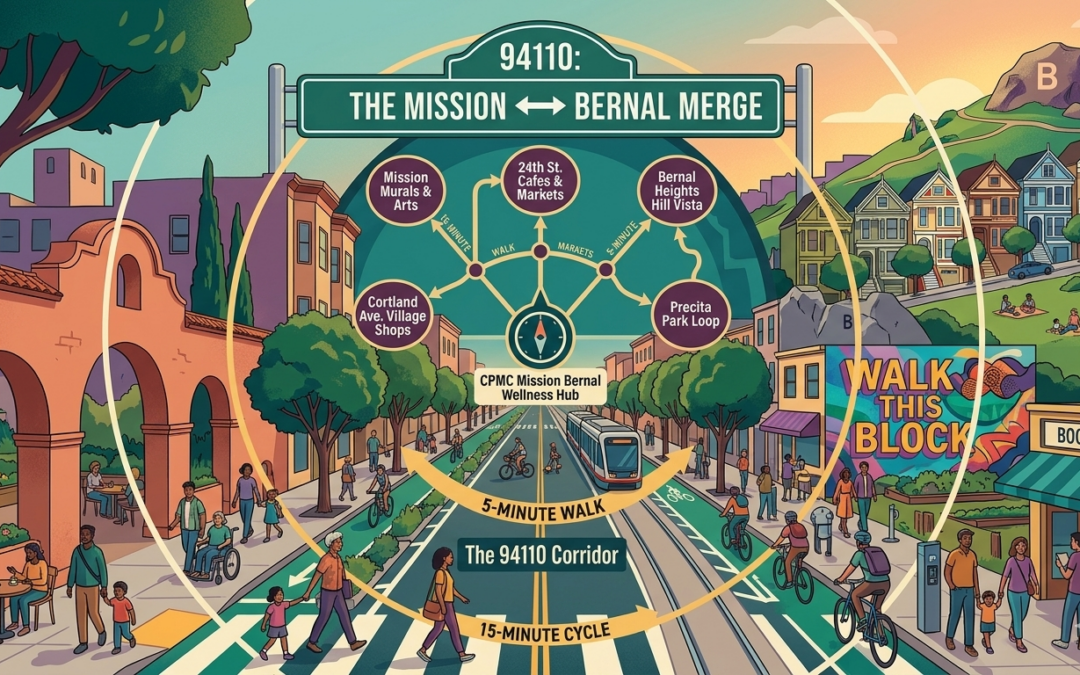
The 15-Minute Neighborhood:
How Bernal and the Mission are Quietly Merging into a Walkability Powerhouse
For decades, the invisible border of Cesar Chavez Street served as a psychological and physical divide between the vibrant, gritty energy of the Mission District and the village-like serenity of Bernal Heights. In 2026, that line has all but vanished.
Driven by the “15-minute city” model, a framework popularized by urbanist Carlos Moreno, which posits that every daily necessity should be reachable within a short stroll, the 94110 corridor has transformed into one of San Francisco’s most formidable walkability powerhouses. What was once a transition zone is now the heart of a hyper-local ecosystem that rewards those who travel on foot.
The Rise of the Wellness Anchor
At the center of this merger sits the CPMC Mission Bernal Campus. Far more than just a medical facility, the campus has become a massive community anchor. Its presence has spurred what urban planners might call a “wellness micro-climate” in the surrounding blocks. New businesses focusing on holistic health, alcohol-free social spaces, and organic provisions are clustering in the shadow of the hospital, catering to a demographic that values longevity and local accessibility. This medical hub effectively bridges the gap, drawing foot traffic from both the Mission and Bernal flats into a shared central plaza.
The “Cortland-to-Valencia” Lifestyle
The real magic of the 94110 walkability powerhouse is the diversity of the “loop.” A resident can start their morning with a hike up Bernal Hill, grab a world-class espresso on Cortland Avenue, and within fifteen minutes, be browsing the artisanal markets of 24th Street or attending a gallery opening.
This connectivity is celebrated annually during the Earth Day Stroll, which highlights the community-led sidewalk gardens and “pocket parks” that have sprouted along the side streets. These small-scale volunteer projects act as a living map, guiding pedestrians through a continuous landscape of neighborhood charm that makes the trek between districts feel like a unified experience.
The Micro-Neighborhood Pivot
This isn’t just about convenience; it’s about a shift in identity. People are moving away from broad neighborhood labels and identifying with the specific five-block radii where the community is tightest, places like the slope where the Mission meets the northern base of the hill. Here, the distinct cultural vibes of both neighborhoods blend into something entirely new, fostering a unique sense of belonging accessible only on foot.
A Model for the Modern City
The 94110’s quiet merger serves as a living blueprint for modern urbanism. By focusing on community-centric anchors and supporting small-scale business corridors, these two historic districts have created a resilient, walkable paradise. In this part of San Francisco, the car is increasingly becoming secondary to the sidewalk, proving that the best way to experience the city’s pulse is one step at a time.
Four Corners of the Hill

Author: Mike Doherty: Bernal Connect
Mike Doherty serves as Chief Experience Officer at Greening Projects, a nonprofit organization dedicated to transforming underutilized urban spaces into vibrant green areas that benefit communities and the environment.
